Are you ready for a quick journey discovering Polish food? In the following I will present my personal highlights of the Polish cuisine that I experienced throughout my volunteering experience in Poland. As food is always a matter of taste, the article may consist of highly subjective statements.
Stop 1: Why everything starts with a soup
Welcome to Poland, or welcome to the Polish winter! When it’s cold, the body needs something warm and comforting. This explains why Poland is in the top 15 countries when it comes to global tea consumption by country, and this explains why soups are an established part of Polish cuisine.
Zupa pomidorowa (tomato soup), zupa ogórkowa (pickles soup), krupnik (barley soup), rosół (chicken soup), flaki (guts soup) and barszcz (beetroot soup) – I can wholeheartedly recommend the entire selection. As someone who is not particularly a big fan of soup, I must say that this is quite impressive. Polish soup culture shaped me insofar as I would not underestimate the beauty of a warm and filling soup anymore. Food can also contribute to a learning experience :)!
Stop 2: Why pierogi are the best dumplings
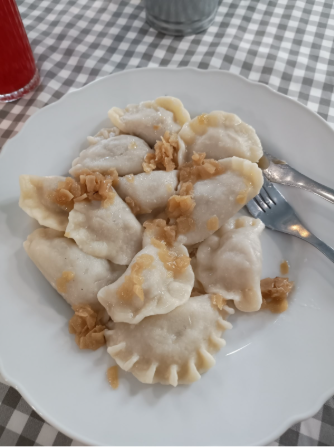
The next stop needs to be of course, of course, pierogi. The famous Polish dumplings have all sorts of fillings, from sweet to salty. My personal favourites are mięsem (meat) and kapustą i grzybami (sauerkraut and mushrooms), but I really like selecting different fillings each time and to explore the various tastes of these delicious dumplings.
Maultaschen, gyozas, samosas, momos, ravioli: dumplings can be found all around the world. But what makes the Polish pierogi special and unique? Firstly, they have the perfect consistency, the right balance between dough and filling, and secondly, pierogi is a comfort food. The filling may not consist of 100 spices but rather common ingredients, and this is the reason why I can eat pierogi every week. Pierogi can be eaten everywhere in Poland, but my recommendation is to search for little restaurants that sell and produce only pierogi, the so-called pierogarnias.
Stop 3: Why you should eat at a bar mleczny
Polish food is obviously much more than just soups and pierogi. The best place to experience authentic Polish cuisine is the bar mleczny. The bar mleczny, which translates to milk bar, is a Polish cafeteria and a concept that has existed for quite a long time (for historical details you can find much more information on the World Wide Web). As someone from Germany, I find the prices here fair and affordable. From my experience, you can easily find meals for less than 20 złoty, which is less than 5 euros and entire menus that are huge in terms of quantity for less than 30 złoty, which is around 7 euros.
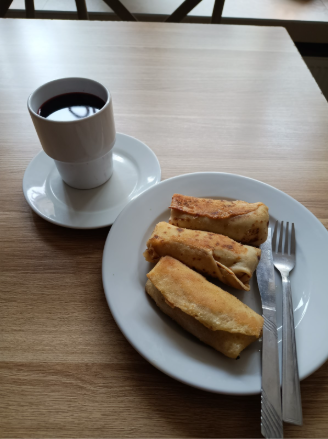
What can I recommend foodwise? As I recommended the pierogarnias for eating pierogi, I would recommend choosing something else in the bar mleczny. The classic choice for many Poles is the kotlet schabowy. This is a breaded cutlet of pork, or as I would call it, the Polish interpretation of a Wiener Schnitzel. Another good choice is płaczki ziemniaczane, potato pancakes. If you search for the ideal combination for your soup, I can warmly recommend krokety, a savoury Polish pancake rolled and stuffed usually with a meat or sauerkraut filling. Speaking of pancakes, Polish cuisine also has to offer some delicious desserts. But every journey needs to come to an end, so I will leave the discovery of desserts and other amazing food up to you. Enjoy your meal, Smacznego!
Kris Schneider, Schuman Volunteer 2025/2026